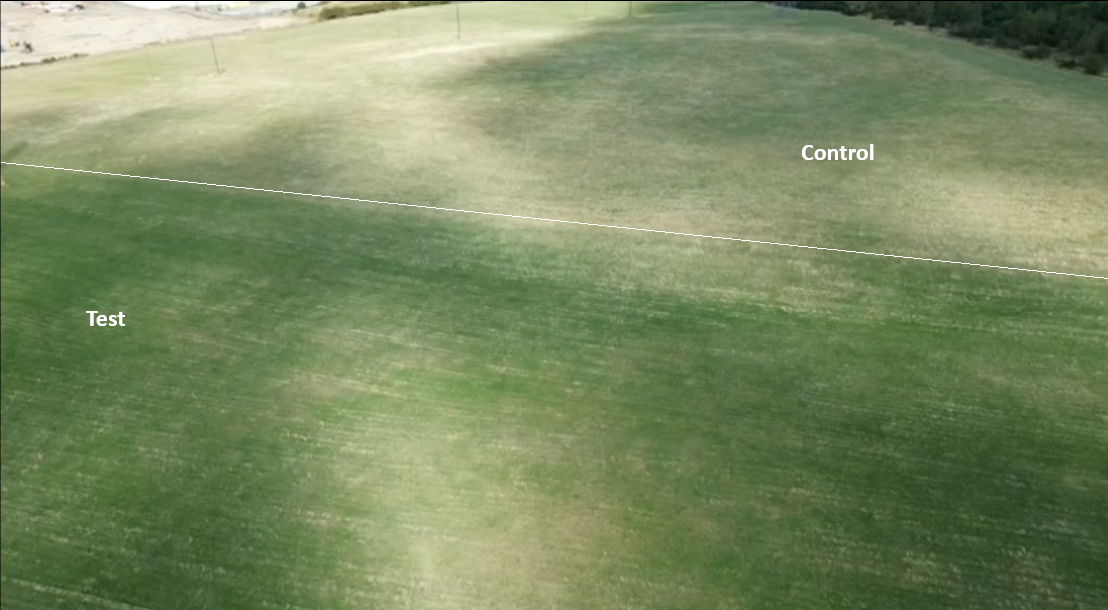
In June 2025 a single application of SoilPoint Soil Booster went on at 5 L/ha over a block of well-established organic permanent pasture set aside for hay. Nothing else was applied — no manure, no slurry, no synthetic fertiliser — and the ground carried no grazing stock across either trial year. Fourteen months later, under appreciable drought stress, the treated half cut 11.75 bales of hay per acre against the control's 7.2.
Over twelve years of records the field has produced 7.5 to 8.5 bales per acre. The treated half this year beat the best of those twelve years by 38%; the control fell below the worst of them. The effect was present in the first season and larger in the second, with nothing applied in between.
The headline, in one table
| Measure | Control | SoilPoint | Difference |
|---|---|---|---|
| Hay yield (bales/acre) | 7.2 | 11.75 | +63.2% |
| Hay yield (kg/ha, fresh) | 4,359 | 7,317 | +67.9% |
| Water infiltration (mm/hr) | 31.1 | 68.3 | +119.6% |
| Post-harvest regrowth (kg DM/ha/day) | 37.6 | 63.4 | +68.6% |
| Canopy index (NGRDI) | 0.04 | 0.29 | — |
| Regrowth, 2025 application year (kg/ha/day) | 28 | 39 | +39% |
The trial
Sixty acres of permanent pasture that receives no farmyard manure, slurry or synthetic fertiliser, cut once a year at the same point each season with the aftermath left in place. The parcel was split almost exactly in half, roughly 30 acres each, with the dividing line running up and down a single even slope so both halves share the same elevation, aspect and drainage; the field's two weaker areas sit one in each half. SoilPoint Soil Booster was applied at 5 L/ha in June 2025, and this reports the SoilPoint-alone swath against the untreated control.
Beaten only by its own best year
Stated against the best year in the twelve-year record rather than the mean, the result is +38.2% — the figure worth quoting, because it gives up a large margin and removes an entire line of argument.
| Reference | Bales/acre | SoilPoint (11.75) vs |
|---|---|---|
| Control, same season | 7.2 | +63.2% |
| Twelve-year mean | 8.0 | +46.9% |
| Best of twelve years | 8.5 | +38.2% |
| Twelve-year minimum | 7.5 | — |
Water infiltration more than doubled
A rate near 31 mm/hr is typical of compacted or structurally degraded loam; above roughly 40 mm/hr is the range taken as well-structured soil. The treated ground sat comfortably inside it at 68.3 mm/hr; the control did not. Under drought the consequence is direct — water that does not infiltrate never reaches the root zone.
Still growing through the drought
National grass growth was running more than 40% below the recent average through July 2026. The control, at 37.6 kg DM/ha/day, behaved as a drought-stressed sward should; the treated ground was recovering at 63.4, a rate that would be unremarkable in an ordinary year. Both plots were cut on the same day to the same height and measured on the same dates with the same instrument — the cleanest comparison in the 2026 data.
Soil biology
| Measure | Control | SoilPoint | Difference |
|---|---|---|---|
| Microbial biomass (mg/kg) | 932 | 3,924 | ×4.2 |
| Soil respiration (mg/kg) | 41 | 177 | ×4.3 |
Each figure is a single bulk aggregate of around twenty cores per plot, so there is no variance and no test — but both samples travelled together, so transport bears on the absolute values rather than the gap between them.
The effect grew in year two
A treatment that worked by feeding the crop would produce its largest response in the year it went on and a decaying one after. This ran the other way: moderate in 2025 (+39% regrowth), substantially larger in 2026, with nothing applied in between — which points to a change in the soil rather than a feed.
Forage quality, and a shift toward clover
| Measure | Control | SoilPoint |
|---|---|---|
| Crude protein (g/kg) | 140 | 149 |
| Neutral detergent fibre (g/kg) | 575 | 542 |
| Metabolisable energy (MJ/kg) | 9.6 | 9.2 |
Higher protein with lower fibre and lower digestibility together is what a sward shifting towards clover produces — and clover appeared more abundant on the treated ground across both seasons. This is the least robust data in the trial (single samples, hot-weather dispatch) and the clover is a visual observation rather than a botanical count, so the pattern is reported because it is coherent, not because it is proven. If it is real it matters, because clover fixes its own nitrogen.
What it cost
| Item | Rate | £/ha |
|---|---|---|
| Product | 5 L/ha at £7.50/L | 37.50 |
| Baling, 11.2 additional bales | £4.78/bale | 53.74 |
| Bale chasing, 11.2 additional bales | £3.56/bale | 40.03 |
| Total additional cost | 131.27 |
The treatment pays for itself if the extra 2.96 tonnes of fresh hay per hectare is worth more than £44/t — or each additional bale more than £11.68. Against any realistic farmgate or replacement value for hay, particularly in a drought year, that threshold is cleared by a wide margin.
How far this goes
This is one field, one season of side-by-side yield data, one plot per treatment. No statistical test is possible and none is offered — it is a case study, and establishes nothing on its own. What it records is an effect large enough to be worth measuring properly, on ground where the two most obvious alternative explanations have been substantially closed off: both halves sat through the same drought, and both were destocked at the same time for the same duration, yet the control still produced only 7.2 bales per acre.
The measurement that stands out is infiltration. Humic substances act as binding agents in soil, and better aggregation opens the pore space through which water enters the profile — which under drought is the difference between a crop that keeps growing and one that stops. A physical change to soil structure would also persist in a way a nutritional effect could not, which fits an effect that grew across two seasons. That is where the evidence points; nothing here tests it.